
It's 9:40 at night. You're walking to your car on a side street off Hollywood Boulevard, keys between your fingers, doing the thing where you walk a little faster and pretend you're not.
You've thought about a self-defense class for years. Maybe for you. Maybe for your daughter, who's about to start taking the bus on her own. You just don't know whether a Saturday seminar is enough, or whether you'd actually need to learn how to fight.
Fair question. People walk through our door for exactly this reason every week, and this is what we tell them.
Short version: Real self defense is awareness first, then a martial art you practice against a resisting partner every week. Jiu jitsu handles the ground and lets you control someone bigger without hurting them. Muay Thai keeps people off you on your feet. A one-day seminar won't stick. Regular classes will. Two schools in Los Angeles, Hollywood and Commerce, and your first class at RGLA is free.
What does real self defense start with?
It starts before anyone touches you. Head up, phone in your pocket, and the willingness to trust a bad feeling and leave. Most of self defense is noticing the guy who's been walking behind you for two blocks and crossing the street early. That's not paranoia. That's paying attention.
Then there's the part a seminar can't give you. Under adrenaline, you don't rise to the occasion. You fall back on whatever you've done hundreds of times. A one-day class teaches you a move. A year of classes teaches your body. That's the difference between knowing what a hip escape is and doing one while someone's weight is crushing your chest.
So the question isn't "which self-defense system is best?" It's "which one will you actually train every week?"
Is jiu jitsu good for self defense?
Yes, and it's especially good for the situation most people are actually afraid of: someone bigger grabs you, or you end up on the ground. Brazilian Jiu Jitsu is built around position, angles and control. You learn to use your hips and your whole body against someone's one arm, to hold a larger person down, and to finish with joint locks and chokes if you have to.
The part people don't expect is control without damage. You can pin someone and wait. You can choose not to hurt them. For a parent, a teacher, or anyone who'd rather not throw a punch, that matters more than any highlight reel.
What does it look like in practice? Your first month, somebody 40 pounds heavier sits on your chest and you can't move. It's awful. Three months later you're the one on top, breathing through your nose, and the person underneath is the one panicking. That's a feeling no seminar sells.
What does Muay Thai add that jiu jitsu doesn't?
Distance and striking. Muay Thai is called the art of eight limbs because you hit with punches, kicks, elbows and knees, and it teaches you to keep someone off you while you're still on your feet. Elbows and knees work at close range, where a punch has no room.
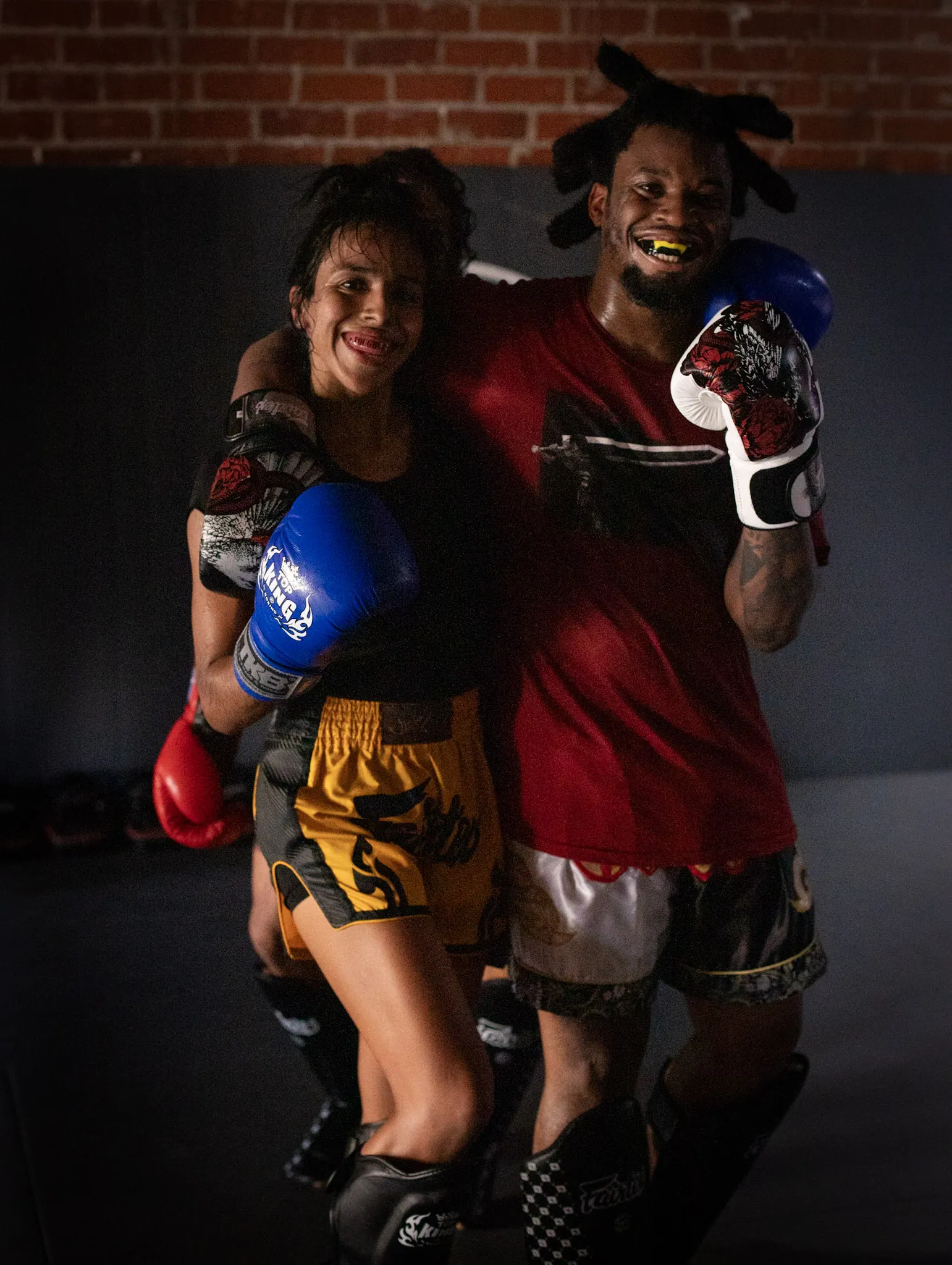
It also teaches something quieter: how to stay composed when something is coming at your face. Pad rounds and controlled sparring make that normal. The first time you get hit in class and realize you're fine, a lot of fear you didn't know you were carrying just leaves.
Put the two together and you've got both ranges covered. Muay Thai while you're standing, jiu jitsu if it goes to the ground. In our experience, the people who come in for self defense and stick around usually end up training both.
What should you look for in self defense classes in Los Angeles?
Four things, and you can check all of them by watching one class. Skip any school that won't let you.
- Instructor credentials. Who did they train under? What belt are they? How long have they been teaching, not just training? A real lineage means the material has been tested by a lot of people before you.
- A curriculum. Not a highlight reel of cool moves, but a progression. Fundamentals classes that build on each other, so a beginner isn't learning flying armbars on day two.
- The environment. Are beginners welcomed or ignored? Are the mats clean? Does anyone smile after class? You'll be spending a lot of hours here. It should feel like somewhere you'd want to be.
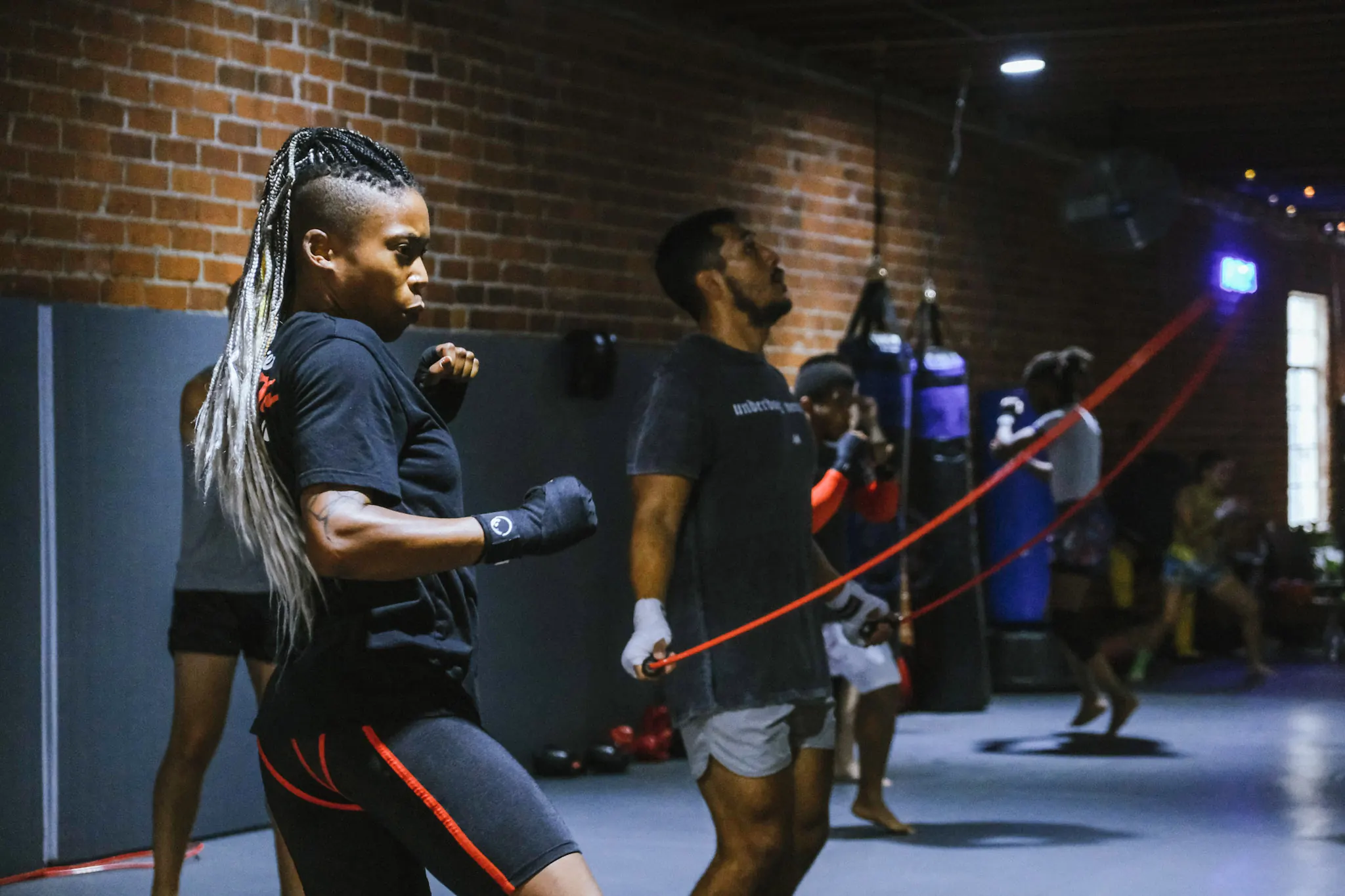
- Live practice. This is the big one. You need to drill against a partner who's resisting. Rolling. Sparring. Pad rounds with someone hitting back. If it's all choreographed, it isn't self defense.
If you're a woman wondering whether you'll be the only one on the mat, you won't be. Women train here every day, and a Women's Jiu Jitsu class runs on Sundays at noon.
Can you take self defense classes as a family?
Yes, and it works better than you'd think. Your kid trains in a kids class while you train in an adult one, and suddenly you're talking about the same things at dinner. What position they got stuck in. Who they helped up. Whether they tapped early or waited too long.
For kids, the goal isn't to make them fighters. It's to teach them to stay calm, hold their ground, and get away, so the kid who gets shoved at recess doesn't freeze and doesn't swing wild. Little Lions starts at age five and Junior Lions picks up at eight, so there's a class that fits whether your kid is small and shy or big and bouncing off the walls.
And the parent learns the same lesson the kid does. You don't have to be scary to be safe.
What you get that has nothing to do with fighting
Confidence, mostly, and not the loud kind. The quiet kind that comes from having been in bad positions and handled them. Along the way you get in shape almost by accident, you learn to stay calm when your heart is pounding, and you pick up discipline, perseverance and self-control because the mat demands all three.
You also get people. The training partners who show up at 7am, the ones who fix your grip on the walk to the water fountain. People walk in here for self defense. They stay for the people. Funny how that works, isn't it?
Two schools in Los Angeles, one first step
There are two of us in Los Angeles. Renzo Gracie LA is on Hollywood Boulevard. Our sister school, Renzo Gracie East LA, is in Commerce. Both have a mix of martial arts classes and both have beginners walking in every week, so pick whichever one is closer to your couch. The class you can get to beats the class you meant to get to.
So here's the ask. Stop rehearsing the walk to your car and go learn what to do. Book a free first class, tell the coach why you're there, and we'll take it from that first bow.
Questions people ask
Is jiu jitsu or Muay Thai better for self defense?
They do different jobs. Muay Thai keeps someone off you while you're standing and teaches you to hit with hands, elbows, knees and shins. Jiu jitsu takes over when you're grabbed or on the ground and lets you control a bigger person. If you can only pick one to start, pick the one whose schedule you'll actually make.
How long does it take to be able to defend yourself?
In our experience, you feel a real difference after a few months of consistent classes, two or three a week. Not because you're dangerous yet, but because being grabbed, pinned or hit stops being a panic moment. Real skill takes years. The calm shows up early.
Do I need to be in shape before I start self defense classes?
No. Fundamentals classes are built for people who haven't exercised in years. You get in shape by training, not before it. Tell the coach it's your first day, go at your own pace, and tap early. Nobody's watching you as closely as you think.
Is self defense training safe for kids?
Yes, with the right program. Kids classes at RGLA are structured, supervised, and built around control, not aggression. Little Lions is ages 5 to 7 and Junior Lions is 8 to 12. Kids learn to stay calm, hold their ground and get away, and the discipline follows them to school.